

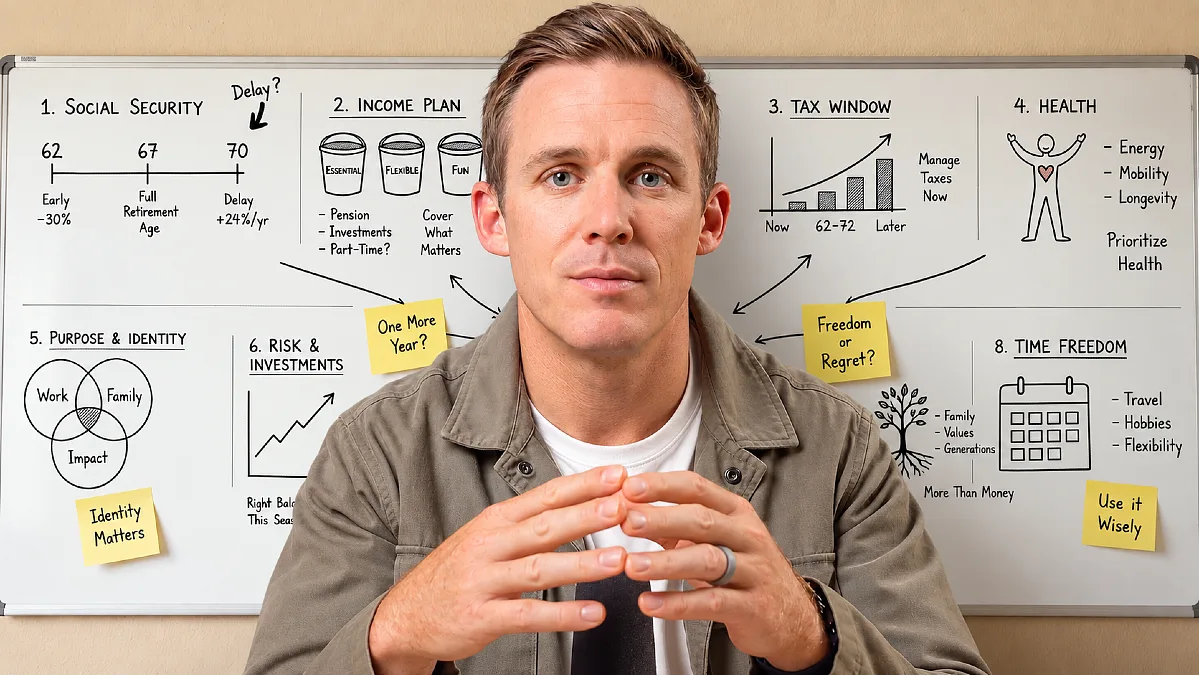
Turning 62 can make retirement feel close enough to touch, yet this is also where good savers can make an expensive mistake.
Social Security becomes available, Medicare is only three years away, and another year of work can make an already strong portfolio look even safer.
James Conole’s advice is to resist making the decision on momentum alone.
His framework asks a harder question: if the numbers already support the life you want, are you still working for a clear reason, or simply because stopping feels uncomfortable? The answer changes how you should plan the next decade.
Why Age 62 Deserves More Than a Social Security Decision

Age 62 gets attention because it is the first age at which most workers can begin Social Security retirement benefits.
For someone turning 62 in 2026, however, claiming immediately can mean receiving 30% less than the worker’s full retirement benefit because full retirement age is 67 for people born in 1960 or later.
That makes Social Security important, but Conole’s argument is that it should not become the entire retirement decision. Retiring from work, starting Social Security, enrolling in Medicare, taking portfolio withdrawals, and beginning RMDs all happen on different schedules.
Here is what the timeline looks like for many people turning 62 in 2026.
| Retirement milestone | Age or 2026 figure | Why it matters |
|---|---|---|
| Earliest Social Security retirement benefit | 62 | Benefit may be permanently reduced |
| Full retirement age for 1960 or later births | 67 | Worker receives 100% of primary insurance amount |
| Maximum delayed retirement credit age | 70 | Credits stop after 70 |
| Medicare eligibility for most people | 65 | Creates a health coverage issue if retiring earlier |
| 2026 earnings test limit under FRA | $24,480 | Benefits may be withheld if working while claiming |
| RMD age for someone born in 1964 | 75 | Creates years for possible tax planning |
The surprising part is the space between these ages. Someone could leave work at 62, delay Social Security, move onto Medicare at 65, receive the full retirement age benefit at 67 or delay longer, and wait until 75 before current law generally requires RMDs.
That is why one age should not make every decision automatically.
James Conole Calls It the Momentum Trap

Conole describes a pattern he calls the momentum trap. At 62, a person may have one of the highest salaries of a career, a large retirement balance, fewer family expenses, and the knowledge that another year of work will probably add even more financial cushion.
Continuing to work can be an excellent choice when the additional income is needed or when someone genuinely enjoys the job. The problem appears when working longer becomes the default simply because working, saving, and watching account balances rise have been the pattern for 30 or 40 years.
Identity matters here as much as money. A person may have spent decades thinking of himself or herself as a teacher, attorney, business owner, engineer, provider, saver, or decision maker, and leaving that identity can feel more frightening than the financial projections suggest.
That does not mean the answer is to quit at 62. It means the question should change from “How much more can I accumulate?” to “What would another year of work allow me to do that my current plan cannot?”
If there is no clear answer, the next step is to examine the retirement plan rather than automatically adding another year to the career.
Build the Retirement Paycheck Before Leaving the Work Paycheck

During the working years, income is easy to understand. A paycheck arrives, retirement contributions leave automatically, bills get paid, and the remaining money can be saved or spent.
Retirement reverses that process. The retiree may suddenly have to construct a paycheck from Social Security, a pension, a taxable brokerage account, traditional retirement accounts, Roth money, cash, and perhaps rental or other income.
Conole places this income plan near the center of the age 62 decision. His source example considers a household wanting $10,000 a month and asks how that spending would be funded before and after Social Security begins.
A simplified household could look like this.
| Income source | Before Social Security | After Social Security starts | Planning issue |
|---|---|---|---|
| Social Security | $0 | $4,500 monthly | Claiming date affects permanent benefit |
| Pension | $1,500 monthly | $1,500 monthly | Check survivor option and inflation features |
| Portfolio withdrawals | $6,500 monthly | $2,000 monthly | Market conditions and taxes matter |
| Total | $8,000 monthly | $8,000 monthly | Sources change even when spending does not |
This is a hypothetical illustration, not a suggested withdrawal plan. The point is that retirement income can change dramatically over the first several years even when lifestyle spending barely changes.
That matters because large portfolio withdrawals early in retirement can expose the household to sequence of returns risk. A market decline becomes harder to recover from when the retiree is selling investments at the same time, which is why withdrawal planning matters alongside asset allocation.
Social Security Should Fit the Income Plan, Not Control It

Delaying Social Security sounds attractive because the monthly benefit grows. For someone with a full retirement age of 67, claiming at 62 can reduce the worker benefit by 30%, while delaying from 67 to 70 generally earns delayed retirement credits of 8% per year.
That does not automatically make 70 the correct claiming age. Someone who stops working at 62 and waits eight years for Social Security needs another source of money during those eight years.
Here is the basic comparison for someone whose full retirement age is 67.
| Claiming age | Approximate worker benefit versus FRA amount | Main advantage | Main tradeoff |
|---|---|---|---|
| 62 | 70% | Income begins sooner | Permanently smaller monthly benefit |
| 67 | 100% | Full retirement age benefit | Five years without benefits if retired at 62 |
| 70 | 124% | Largest delayed benefit under current rules | Portfolio or other income may need to bridge eight years |
Fidelity and Schwab both emphasize that claiming age should reflect health, longevity, income needs, and other retirement resources rather than one universal rule.
There is another issue for people who claim at 62 while continuing to work. In 2026, someone under full retirement age all year can earn $24,480 before the Social Security earnings test begins withholding $1 of benefits for every $2 earned above the limit.
Those withheld amounts are later reflected through a benefit recalculation at full retirement age, so the earnings test should not simply be described as a permanent tax or loss.
The better question is therefore not “What is the best age to claim?” It is “Which claiming date works best with the rest of this household’s income plan?”
Retiring at 62 Creates a Three Year Medicare Question

A person can claim Social Security at 62, but Medicare generally does not begin until 65. That creates one of the most important practical differences between being able to retire and being financially ready to retire.
A 62 year old leaving employer coverage may need insurance through a spouse, COBRA for an allowed period, an Affordable Care Act marketplace plan, retiree coverage, or another available option.
Premiums, deductibles, prescription costs, provider networks, and potential marketplace subsidies all need to be considered before the resignation letter is submitted.
For most people, Medicare’s Initial Enrollment Period lasts seven months. It begins three months before the month they turn 65 and ends three months after that birthday month, although rules can differ when someone has qualifying employer coverage or falls into another special situation.
That makes age 62 a good time to price the healthcare bridge. A retirement plan that works only because it assumes Medicare begins immediately at retirement has a serious hole in it.
Use the Tax Planning Window Before RMDs Begin
Conole’s next major point is that retirement can change a household’s tax planning opportunities.
During the working years, W2 income often determines much of the tax picture, while retirees may have more choice about whether cash comes from taxable accounts, traditional retirement accounts, Roth accounts, or Social Security.
For someone turning 62 in 2026, current RMD rules are especially interesting. That person was born in 1964, and current IRS rules generally set the applicable RMD age at 75 for people born after 1959.
That creates a potential 13 year stretch between 62 and 75. It will not be a low tax period for everyone, but it gives some retirees time to decide how much pretax money to convert or withdraw before mandatory distributions begin.
| Possible move | Why retirees consider it | Important caution |
|---|---|---|
| Roth conversion | Move pretax funds into Roth while taxable income is manageable | Conversion itself creates taxable income |
| Tax gain harvesting | Realize long term gains in a lower tax year | Capital gains stack with other taxable income |
| Traditional IRA withdrawal | Fill part of annual spending need | Raises taxable income |
| Delay Social Security | May increase future monthly benefit | Requires income from somewhere else |
| Use taxable savings | Can reduce immediate IRA withdrawals | May trigger gains and reduce liquid reserves |
For 2026, the federal 0% long term capital gains band reaches taxable income of $49,450 for most single taxpayers and $98,900 for married couples filing jointly. That does not mean a retiree can simply sell that amount of appreciated stock tax free because other taxable income also uses the same income space.
The correct tax strategy can therefore be counterintuitive. The lowest possible tax bill this year is not always the best long term tax result if it causes a much larger traditional IRA balance and larger taxable withdrawals later.
Review Insurance for the Life You Have Now

Insurance purchased at 35 may not match the risks a household faces at 62. A large term life policy may have been essential when the mortgage was new, children depended on one income, and investment accounts were small.
Thirty years later, some of those risks may have disappeared. Other risks may have grown because the home is worth more, investment assets have increased, or a liability claim could now threaten a much larger net worth.
Conole recommends reviewing the purpose of existing coverage instead of renewing policies automatically. His source discussion specifically raises life insurance, disability coverage, property and casualty insurance, umbrella liability protection, and long term care exposure.
Long term care deserves special attention because the financial effect can reach beyond the person receiving care. For a married household, a major care expense can reduce assets that the surviving spouse may need for many more years.
That does not mean everyone should buy long term care insurance. It means the retirement plan should answer what happens if extended care becomes necessary and identify whether savings, insurance, home equity, family support, or another strategy is expected to cover it.
Give the Portfolio a Job Instead of Just a Bigger Balance

One of Conole’s strongest ideas has little to do with investment selection. He argues that a portfolio should eventually be connected to something the owner actually values rather than being allowed to grow without a defined purpose.
That purpose might be ordinary living expenses. It might also include travel, helping grandchildren, giving to charity, spending more time with family, maintaining a home, paying for care, or leaving an inheritance.
This distinction matters because accumulation can become a habit. A person reaches $1 million, then wants $1.5 million, then $2 million, even though no calculation has been made showing what the extra money will change.
The better process works backward. First define the retirement lifestyle, then estimate its cost, then identify dependable income, and only then determine how much the portfolio needs to supply.
That does not make portfolio growth unimportant. It simply puts growth back in its proper role as a tool rather than the final score.
A Retirement Readiness Check for Age 62
There is no single portfolio balance that makes someone ready for retirement. A renter spending $45,000 annually and a homeowner supporting family while spending $140,000 annually cannot be judged by the same savings target.
A better age 62 review looks across the whole household.
| Area | Stronger position | Warning sign |
|---|---|---|
| Spending | Expected retirement spending has been estimated | Budget is based on a guess |
| Income | Social Security, pensions and withdrawals have been coordinated | No plan exists for replacing the paycheck |
| Healthcare | Coverage is identified through age 65 and beyond | Plan assumes Medicare begins at 62 |
| Taxes | Several future tax years have been modeled | Withdrawals are chosen only by convenience |
| Portfolio | Withdrawal needs and downturn risk have been tested | Success depends on strong markets every year |
| Insurance | Old policies and new risks have been reviewed | Coverage has been on autopilot for decades |
| Lifestyle | Retirement time has a clear purpose | The only plan is “stop working” |
No one needs a perfect score in every row. The table is meant to expose the questions that deserve work before a major decision becomes irreversible.
A person who discovers two or three weak areas may still be close to retirement. Those gaps simply tell the household what needs to be solved first.
What James Conole’s Advice Does Not Mean
Conole’s framework should not be read as “everyone should retire at 62.” Continuing to work can be financially valuable, and some people enjoy the structure, relationships, purpose, health coverage, pension accrual, employer contributions, or income that employment provides.
It also does not mean everyone should claim Social Security at 62. The permanent reduction can be substantial, while delaying can create a much larger monthly benefit for someone with the resources and circumstances to wait.
Instead, his age 62 message challenges automatic decisions. Continuing to work should have a reason. Delaying Social Security should have a reason. Spending more from the portfolio should have a reason, and refusing to spend from it should have a reason too.
The same principle applies to taxes and insurance. A strategy that worked brilliantly during accumulation may not remain the best strategy once wages disappear and retirement income begins.

Marco Kelley is a Retirement writer focused on helping older adults make confident, informed decisions about life after work. He covers retirement planning, Social Security, savings, taxes, healthcare costs, senior benefits, housing, and everyday financial choices. Marco brings a practical, straightforward approach to topics that can often feel complicated.
His goal is to give retirees and those nearing retirement clear guidance, useful ideas, and realistic strategies for building a more secure and comfortable future.